A Familiar-Route Listening Walk for Every Season
A familiar-route listening walk helps you notice seasonal sound layers on a route you know, with simple prompts for choosing a safe place and pace.
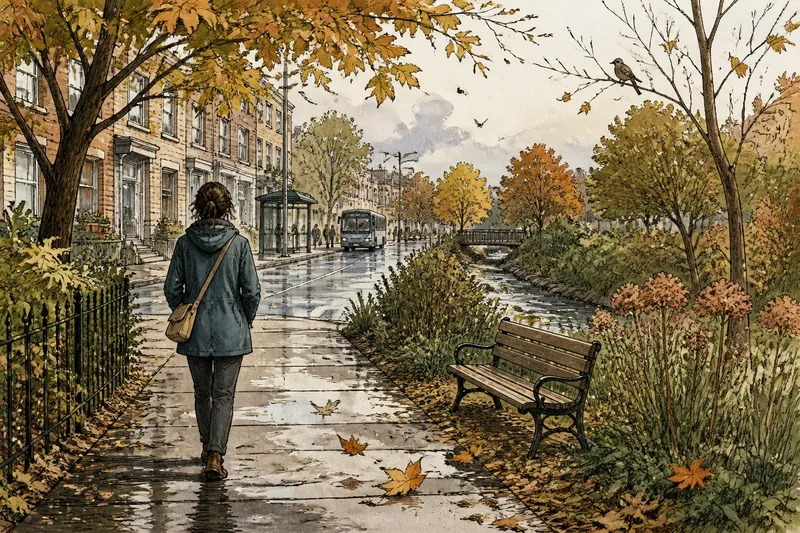
Your usual block sounds different after rain: tires hiss on wet pavement, a gutter ticks, and a bird calls from a tree you pass every day. A familiar-route listening walk turns that ordinary trip into a seasonal sound exercise. You keep the route and the walking pace simple, then notice how its distinct layers change with weather, light, and activity.
What is a familiar-route listening walk?
It is an unhurried walk along a route you already know, with attention directed toward sound in layers. Instead of searching for a rare bird or walking to reach a destination, you listen for what is near, what is farther away, and what rises and fades around you.
Choose a route that gives you a few different listening settings, such as a residential sidewalk, a small park path, or a stretch beside a courtyard. A familiar route makes it easier to notice changes because you already know where the crossing is, where traffic tends to pass, and where a quieter pause might be possible.
This is a movement practice as much as a listening one: you continue at a comfortable pace and let attention shift without stopping to record every sound. Think of the route as a shelf of familiar objects. You are not rearranging it; you are noticing which details have come forward today.
How should I choose a route?
Pick somewhere you can walk comfortably without needing to watch a map. A loop can be convenient because it brings you back to your starting point, but an out-and-back route works just as well. Favor sidewalks or paths with clear sightlines and places to pause away from moving vehicles.
Look for a modest mix of sound sources rather than a scenic destination. One route might include leaves, a bus stop, and a small stream. Another might pass a schoolyard, a row of shops, and a tree-lined side street. The sounds do not need to be pleasant or dramatic; ordinary activity gives you useful contrasts.
- Check the walking surface. Choose a route you can manage in the shoes and conditions you have.
- Choose safe pause points. A bench, wide path edge, or public green space is better than a curb beside traffic.
- Keep crossings familiar. Listen only when you can give the road your full attention; look and follow signals before crossing.
- Make room for changing conditions. A route with an alternate sheltered stretch can help if wind or rain becomes uncomfortable.
- Keep the route flexible. Turn back or shorten it if your energy, weather, or surroundings call for a change.
Follow posted access rules and local guidance, and use the surface, clothing, and route choices that suit your circumstances. If a route feels uncomfortable or unsafe, choose another familiar place rather than trying to complete the exercise.
What sound layers should I listen for?
Start with three broad layers. The first is the near layer: your footsteps, fabric moving, a gate closing, or leaves brushing a hedge. The second is the middle layer: voices, a dog’s collar, a delivery cart, or activity in a nearby garden. The third is the far layer: steady road noise, wind across rooftops, a train, or a bell carried from elsewhere.
These are listening prompts, not fixed categories. A bird overhead may feel near, then seem to recede as you walk beneath trees. A low mechanical hum can become the background while a brief conversation takes the foreground. Notice the shift rather than trying to name every source.
Listen for texture and pattern as well as identity. Is a sound continuous, pulsing, rattling, or intermittent? Does it come from one direction or seem spread across the area? Does it grow louder as you approach and soften as you move away? These questions make attention concrete without turning the walk into a test.
How can I notice seasonal changes?
Use the same stretch of route at different points in the year, but do not expect a tidy seasonal soundtrack. Weather, time of day, nearby activity, and building work can all change what you hear. The useful comparison is what this place sounds like on the occasion you are walking, not whether it matches a prediction.
In spring, you might notice birdsong becoming more prominent, rainwater moving through a drain, or outdoor conversation returning to a courtyard. In summer, insects may add a thin, steady layer; open windows can carry household sounds outdoors. In autumn, dry leaves may scrape across pavement, while a gust can briefly blur more distant sounds. In winter, bare branches may make some calls easier to pick out, while wind or wet weather covers others.
Let conditions guide the questions. After rain, what sounds are newly present, and what surfaces make them? On a still day, which distant sound becomes easier to hear? If wind is strong, which nearby sounds remain clear? This approach keeps observation grounded: you listen to the weather and place in front of you rather than relying on a seasonal checklist of expected species.
How do I stay attentive without losing awareness?
Keep your eyes open and your attention available for the route. Listening does not require closing your eyes, wearing headphones, or standing in a risky spot. Around vehicles, cyclists, stairs, crowded paths, or uneven ground, give your surroundings priority and pause the listening exercise.
At a safe stopping place, you can listen for a short stretch, then resume walking. If you prefer to keep moving, let your gaze rest on the path ahead while your hearing takes in the background. Do not chase a sound into a driveway, private property, or an area that feels isolated. The aim is to notice, not to get closer.
For a practical example, imagine you usually walk from your apartment to a neighborhood garden. On a breezy autumn afternoon, you decide to listen on the familiar sidewalk and pause only at the garden bench. You notice your coat sleeve near you, dry leaves skittering at mid-distance, and traffic beyond the trees. If a passing truck masks the leaves, you wait until it has gone and listen again from the bench; the expected result is a clearer sense of how the layers come and go, not a complete inventory of every sound.
Do I need to write anything down?
No. You can finish the walk with a single remembered detail, such as “the fountain was louder after rain” or “wind covered the traffic.” If notes help you pay attention, jot down a few words afterward rather than looking at a screen while you walk.
A small notebook can hold one observation per outing: the condition, the place, and the sound that stood out. Keep the note descriptive. “A low hum stayed under the voices near the corner” gives you something to compare later; “the neighborhood was peaceful” is broader and may hide the detail you actually heard.
There is no need to record sounds or identify every bird. If you do want to learn a sound’s source, make a note and check it later using a reliable field guide or local nature resource. Let curiosity extend the walk without making identification a requirement.
What if the route is noisy or the weather changes?
A noisy route still has layers. Traffic may provide a continuous background, while a crossing signal, footsteps, or a brief call appears above it. You can focus on the edges: where a sound begins, how long it lasts, and what returns when it fades. If noise feels unpleasant or overwhelming, shorten the walk or choose a quieter familiar route next time.
Weather can also change the plan. Wind may make distant sounds difficult to separate; light rain may add a steady patter, while heavy rain can make a walk uncomfortable or obscure hazards. Turn back or seek an appropriate sheltered place if conditions worsen. There is no need to keep walking for the sake of observing a particular sound.
If your usual route is temporarily blocked or busy, use a nearby alternative you know well. The exercise depends on attentive, comfortable movement, not on completing a specific loop. A short walk with a safe pause can still give you a distinct impression of the day’s soundscape.
Which questions help during the walk?
Should I walk in silence?
You do not need to impose silence on yourself or anyone around you. Simply leave headphones off if you want to hear the surroundings, and let ordinary conversation or footfall be part of the soundscape.
Is a park better than a street?
Neither setting is automatically better; each offers different layers. A street may reveal movement and distant traffic, while a park may bring out leaves, birds, and voices, so choose the place where you can walk and pause comfortably.
What if I cannot identify a sound?
Describe its qualities instead: high or low, steady or brief, close or distant. Noticing its pattern and direction is enough for the exercise, even if its source remains uncertain.
How often should I repeat the walk?
Repeat it whenever it suits your routine, perhaps when weather or daylight has noticeably changed. The familiar-route listening walk works best as an invitation to notice, not a schedule you must maintain.
What is a useful way to finish?
Before you head indoors, pause at a safe spot and name one sound that was easy to overlook on an ordinary pass. It could be a drain, a bird, a door, or the soft change in traffic as a light turns. That small observation gives your familiar route a fresh detail to carry into the next walk.
Keep the main search idea simple: a familiar-route listening walk is a way to notice seasonal sound layers while moving through a place you already know. Choose a route that feels manageable, let safety guide where you pause, and allow the sounds to change without asking them to perform on cue.