How the Rest Break Became Part of the Workday
The history of the rest break shows how pauses became part of work schedules and why a break’s meaning still depends on who controls the time.
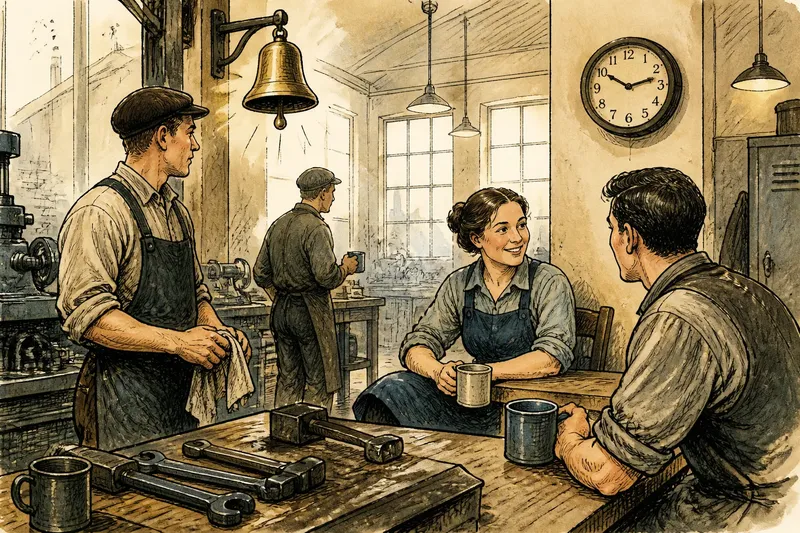
A bell rings in a workshop, and several workers set down their tools. The history of the rest break is not one story shared by every place or period; it is a way to examine how particular workplaces defined time away from a task.
People have always paused to eat, wait, or catch their breath. A scheduled rest break is different: someone marks it as a distinct interval, often within a larger work period. That distinction helps explain why a break can feel like relief, a workplace rule, or a chance to speak with colleagues.
How did people pause before fixed work schedules?
In work organized around tasks and local conditions, pauses could follow the demands of the activity. Someone preparing a meal might wait while it cooked; a person doing outdoor work might stop when weather changed. These are broad illustrations, not a claim that work followed one pattern everywhere.
A pause shaped by the task was not necessarily free time. It might be forced by a delay or filled with another responsibility. The difference between stopping and resting depends partly on whether a person can step away from the immediate task and use the interval for their own needs.
What did the clock change about a break?
In workplaces that coordinated labor by the clock, a schedule could set common times to begin, stop, and resume. This description applies to particular forms of paid work, such as some workshops and factories; it does not describe every job or region. A scheduled pause made time away from a task more visible, and workplace rules could define when it happened and how long it lasted.
A break on a schedule is like a bookmark in a book: it marks a place to stop and return. But a bookmark does not decide whether the reader can take a quiet pause. In the same way, a scheduled interval does not tell us whether a worker can leave a station, eat without interruption, or choose how to spend the time.
Who decides what a workplace break means?
A supervisor may treat a break as part of coordinating work. A worker may value the same interval as time to eat, recover from a task, or talk with colleagues. These meanings can coexist, but the practical experience depends on local rules and daily conditions.
In a particular workplace, a written break rule might set a time while leaving questions about pay, coverage, and interruptions unanswered. Those details vary by job, employer, location, and applicable rules. For a specific employment-rights question, check the relevant local authority or consult a qualified professional rather than relying on a general history.
Say you work at a small service counter and your schedule marks a meal break, but coworkers often bring customer questions to the break room. You tell the person covering the counter when you are stepping away and agree on how urgent requests will reach you. If the arrangement lets you eat without routine interruptions, the break has gained a usable boundary; if questions still come through, you can raise the coverage issue with a supervisor instead.
How did breaks become social customs?
When people share a regular pause, it can become a familiar setting for conversation as well as rest. A lunchroom, staff kitchen, outdoor bench, or quiet corner each supports different kinds of contact. The setting matters: a shared table may invite conversation, while a separate seat can make quiet time easier.
Not everyone wants the same kind of break. Some people prefer company; others need a pause without conversation. A schedule may create an opportunity to gather, but it does not make socializing a requirement or ensure that the setting feels comfortable.
What do people ask about the history of the rest break?
When did rest breaks become scheduled?
There was no single start date for scheduled pauses across all kinds of work. Their form depended on the workplace, its rules, and the way tasks were organized.
Were breaks originally intended for health?
People have paused during work for many reasons, including eating and waiting for a task to continue. It would be too broad to assign one purpose to every break across different places and periods.
Does a scheduled break mean a worker can use it freely?
Not necessarily. A schedule identifies an interval, but conditions such as coverage, interruptions, and workplace expectations shape how usable it is.
Why do breaks feel personal today?
Some contemporary advice describes breaks as individual choices, such as stepping away from a screen or taking a quiet walk. That language can help people notice their needs, but it does not by itself change workplace rules or workloads.
How can you tell what kind of break you have?
Look at the actual conditions rather than the label on the schedule. These observations can help you decide what to adjust or ask about:
- Check whether the break appears on your schedule; if it does, use that time as the planned pause, but if it does not, ask how breaks are arranged for your role.
- Check whether you can leave your work area; if you can, choose a place that suits your needs, but if you cannot, ask what coverage or alternative arrangement is available.
- Check whether work messages or questions interrupt the pause; if they do not, keep using the boundary that works, but if they do, clarify who handles requests while you are away.
- Check whether you can eat or drink comfortably; if you can, use the space provided, but if you cannot, ask whether another suitable place is available.
- Check whether you prefer company or quiet; if the current setting fits, stay with it, but if it does not, choose a quieter or more social location when your workplace allows.
- Check whether the break ends with a clear return point; if it does, follow that plan, but if expectations are unclear, ask your supervisor when and how you should resume work.
The history of the rest break is a reminder that a pause is shaped by boundaries: who sets the time, who can interrupt it, and what happens when it ends. For your next break, notice one specific condition—such as whether you can step away—and use that observation to decide what small change or question would make the pause more usable.